
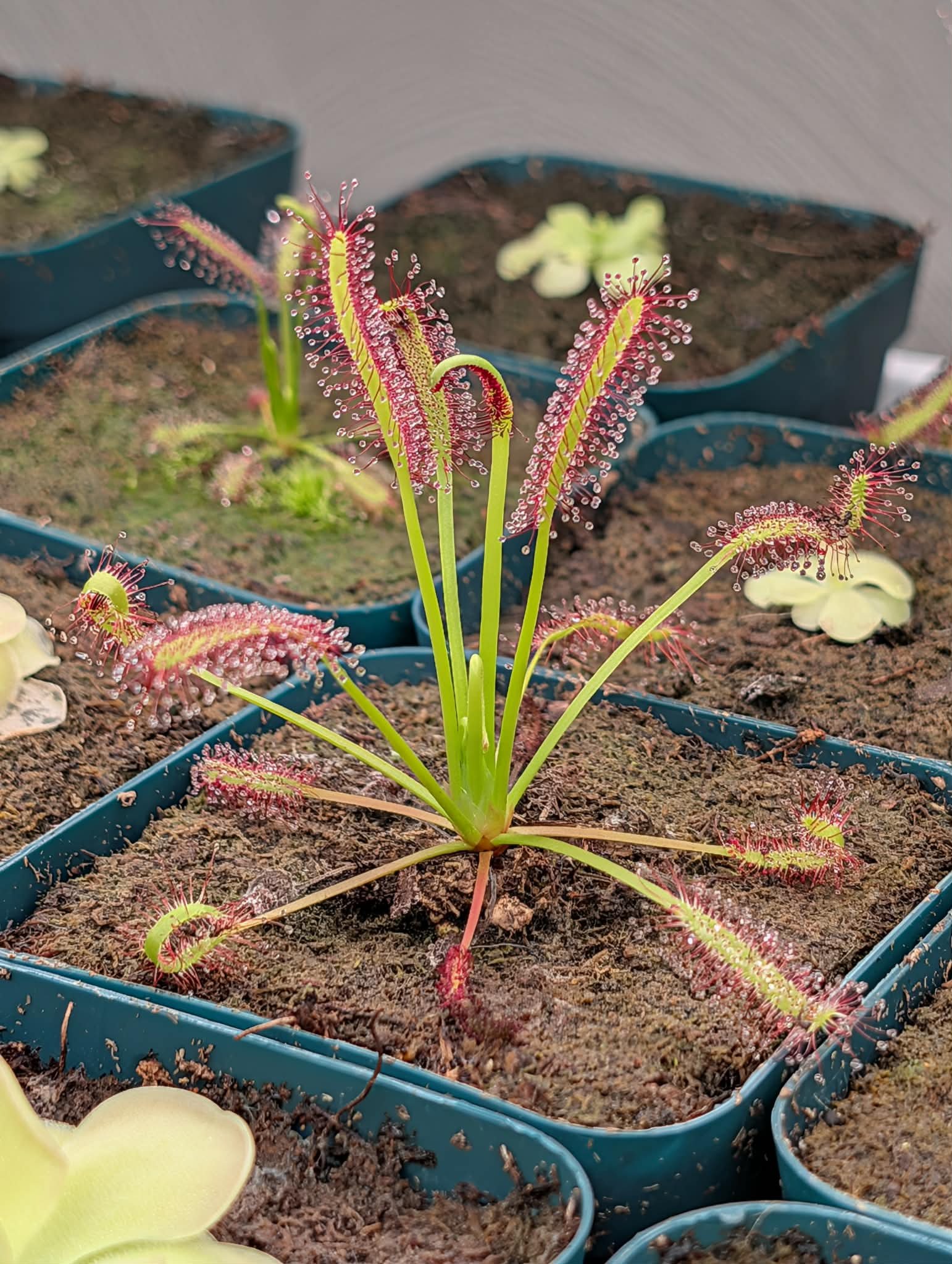
The Sticky Trap: How It Catches Prey
The primary appeal of the Cape Sundew lies in its sticky, sparkling leaves.
Tentacles and Mucilage: The plant's leaves are covered with dozens of fine, hair-like structures called tentacles. Each tentacle secretes a droplet of clear, sticky fluid—a mucilage—that resembles morning dew. This is where the name "Sundew" comes from.
Irresistible Lure: Small insects (like gnats, fruit flies, and mosquitoes) are attracted to the plant's shimmering appearance, mistaking the mucilage for nectar or water.
Capture and Digestion: Once an insect lands on the sticky tentacles, it becomes immediately trapped. In a process called thigmotropism, the surrounding tentacles slowly bend inward to maximize contact with the prey. The plant then secretes digestive enzymes to break down the soft tissues of the insect, absorbing the necessary nutrients (primarily nitrogen and phosphorus) that are scarce in its native soil.
🪴 Essential Care Requirements
To keep your Cape Sundew thriving, it's crucial to replicate its wetland habitat.
Requirement
💧Water Use only distilled, reverse osmosis (RO), or rainwater. Tap water's high mineral content will kill the plant. Keep the pot sitting in about 1inch of water at all times (the Tray Method).
.💡Lighting Requires bright light to produce healthy mucilage. Place in a sunny windowsill that receives at least 4 hours of direct sun daily, or use strong grow lights (LED or fluorescent) for 12-16 hours per day.
🌡️ Temperature Prefers warm conditions, typically between 50F and 85F(10C and 30C). It can tolerate brief dips, but is generally grown as a year-round indoor plant.
🌱 Soil Use a nutrient-poor, acidic mix. The standard ratio is 1 part peat moss to 1 part perlite or silica sand. Never use standard potting soil or compost.
🍲 Feeding The plant catches its own food! Do not fertilize the soil. If grown indoors and prey is scarce, you can occasionally place a small dead insect (like a dried bloodworm) on a leaf.